
“It is long after midnight and students from the Naqsh School of Crafts are still hard at work. Split into groups, we’re creating a large artwork using skills taught by our tutors from The King’s Foundation School of Traditional Arts. But this isn’t homework. Instead, having been inspired by what we have been learning, it’s a challenge that we have set for ourselves.
My father, Yoqubjon, and uncle, Yusufjon Mavlonov, are master craftsmen who have worked on some of Uzbekistan’s most famous buildings, including the Center for Islamic Civilization in Tashkent and the Mausoleum of the Islamic scholar Imam al Bukhari near Samarkand, so I grew up with an interest in ornamental patterns. Yet I found few academic resources to further my knowledge, and it is only since joining the Naqsh School courses that I have begun to better appreciate the beauty and complexity behind them.
The students on the Naqsh School modules have forged a close bond and we are all appreciative of each other’s skill and passion. And we’re certainly grateful to a fellow student at Samarkand State Architecture and Construction University who alerted us to the Naqsh School after spotting a post about the pilot year courses on Instagram.”
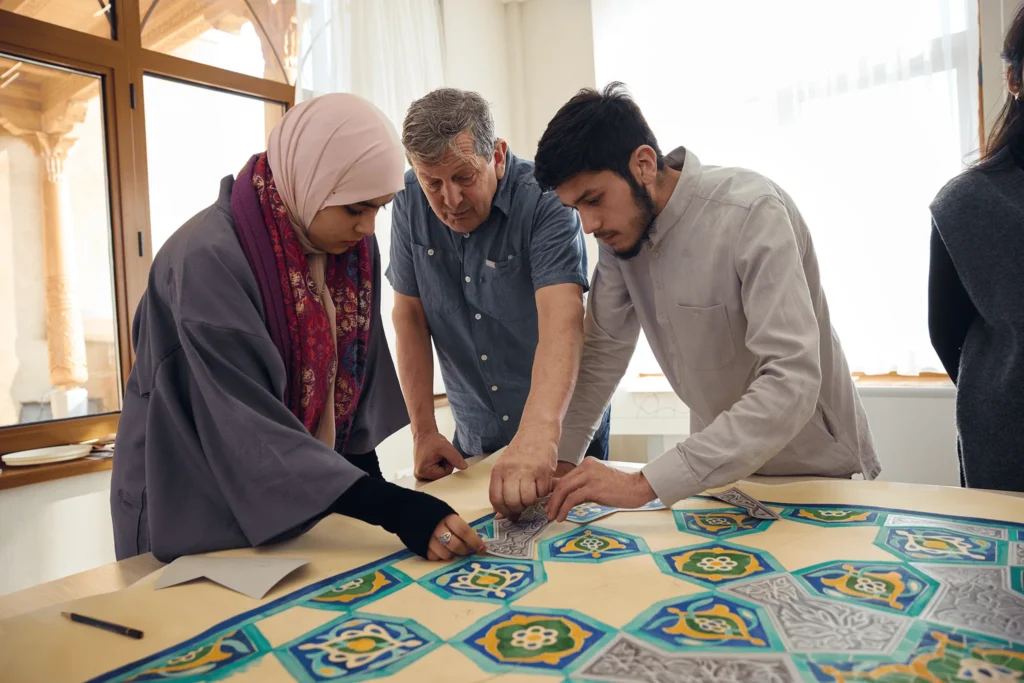
“As I head towards the final year of my four-year architecture degree, the information and inspiration from my time at the Naqsh School is helping to shape my ambitions and those of my fellow students. Indeed, the courses and the ongoing support of the wonderful King’s Foundation team has prompted a group of us to establish Me’mor, an organization that will seek “to revive forgotten architectural traditions through modern digital technologies and pass them on to future generations”.
Me’mor roughly translates as master builder, but more than that, it denotes an artist who embodies deep knowledge of traditional, geometric, and functional design. It is associated with Uzbekistan’s great architects and craftsmen for whom the intellectual and creative aspects of construction were fundamental.
Their work, developed over thousands of years and still inspiring the Uzbek people and millions of visitors from overseas, are as complex as they are glorious. Learning about the use of mathematics to create harmony, balance, and symbolic meaning through principles such as the golden ratio and tenfold geometrical ornaments is challenging, but the team from The King’s Foundation have made for amazing guides. “We all are students. Even us teachers are still learning,” I remember being told by Simon Trethewey, who has been sharing his deep knowledge of the subject for decades.”
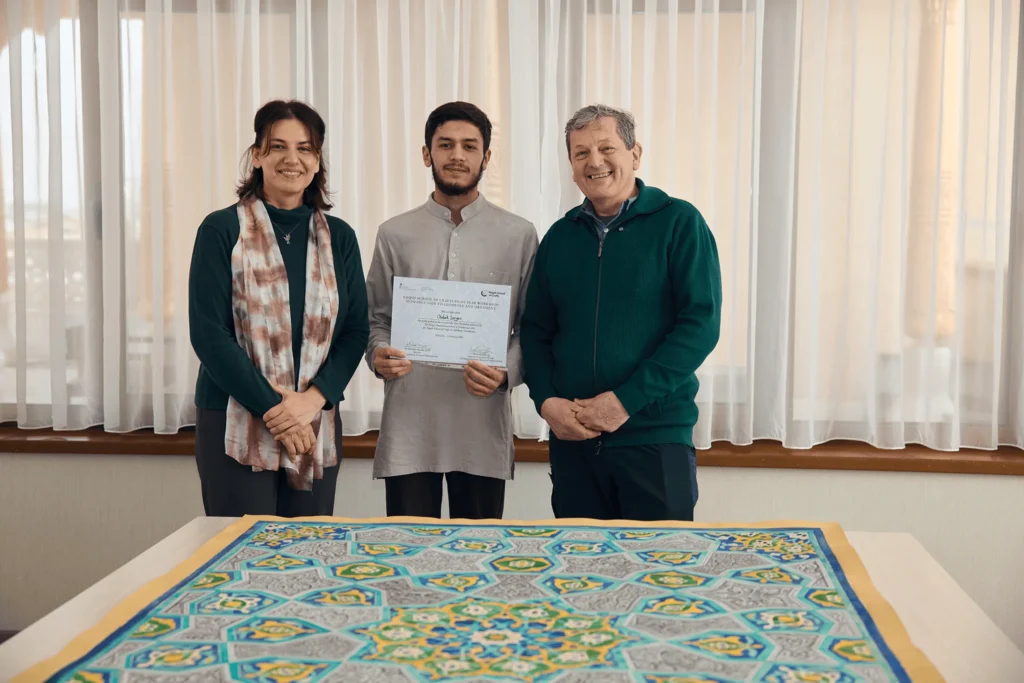
“I have been fortunate to attend both modules so far arranged by The Naqsh School and hope to be accepted to join the third which begins on 30th March. The first course was divided between Tashkent and Samarkand, where we were based in a classroom beneath the mighty arch of the Ulugh Beg Madrasa at The Registan. For the first two weeks of the second module in Tashkent, we learned more about the theory of biomorphic geometry – the shapes that echo the curves and structures found in nature. In the third week, we put that knowledge into practice in the classroom – and back at our hotel.
At the beginning, some were intimidated by the mathematics that underpin the principles but once they converted those new skills into their own designs, and they could see the beauty of what they had made, they were relieved and excited. There is a feeling of pride that we are following in the footsteps of craftsmen who created our distinct Uzbek heritage, and a sense of duty to help ensure that their skills are not lost. For me, art is the soul of humanity, and it’s an honor to be part of the Naqsh School’s mission to preserve it.
At the age of 22, I have seen Uzbekistan transform into a modern, confident country, but that does not mean that we ignore tradition. The contemporary and the traditional should combine and the future will be brighter if we draw inspiration from the past.
I know that all the students are grateful for the support of Samarkand State Architecture and Construction University and Uzbekistan Art and Culture Development Foundation and that each of us would encourage people to enroll for the next courses. There are few opportunities to learn these amazing skills and fewer still to learn them from such inspiring and experienced teachers. My own advice is – be quick.”
by
Otabek Isoyev